
Hell is a Truth of Common Sense


“There really is a Hell. This is the belief of all peoples at every period of history.”
What all peoples have always believed at every period of history is what we call a truth of common sense. Someone who refuses to accept one of these great universal truths would not (as people very rightly say) have common sense. Indeed, you would have to be mad to think that you alone could be right against everyone.
But at every period of history, from the beginning of the world to our day, all peoples have believed in Hell. Though they have given it different names and although their conceptions of it vary in accuracy, they have received, conserved, and proclaimed belief in dreadful and endless punishments (in which there is always fire) for the chastisement of the wicked after death.
This is a certain fact, and it has been so clearly established by our great Christian philosophers that it would be so to speak superfluous to bother proving it.
From the very beginning, we find the existence of an eternal Hell of fire clearly laid down in the most ancient known books, those of Moses. Note well, I am only quoting them here from a purely historical point of view. The very name of Hell is there in black and white.

In the sixteenth chapter of the Book of Numbers, we see the three Levites, Core, Dathan and Abiron, who had blasphemed God and rebelled against Moses, taken down “alive into Hell” (descenderuntque vivi in infernum). And the fire, ignis, which the Lord caused to come out of the earth destroyed two hundred and fifty other rebels.
But Moses wrote this more than sixteen hundred years before the birth of Our Lord, in other words, nearly three thousand five hundred years ago.
In Deuteronomy, the Lord says by the mouth of Moses: “A fire is kindled in my wrath, and shall burn even to the lowest hell” (et ardebit usque ad inferna novissima). In the Book of Job, also written by Moses, according to the greatest scholars, the wicked, whose life is overflowing with riches, and who say to God: “Depart from us, we desire not the knowledge of thy ways. Who is the Almighty, that we should serve him? And what doth it profit us if we pray to him?” in a moment go down to Hell (in puncto ad inferna descendunt).
Job calls Hell “a land that is dark and covered with the mist of death, a land of misery and darkness, where the shadow of death, and no order, but everlasting horror dwelleth” (sed sempiternus horror inhabitat). These are testimonies which are more than respectable and which date back to the most remote historical origins.
One thousand years before Christ, before the time of Greek or Roman history, David and Solomon often speak of Hell as of a great truth which is so known and acknowledged by all that there is no need to even prove it.
In the Book of Psalms, speaking of sinners, David says: “The wicked shall be turned into hell” (convertantur peccatores in infernum). “Let the wicked be ashamed, and be brought down to hell” (et deducantur in infernum). And elsewhere he speaks of the “sorrows of hell” (dolores inferni).
Solomon is just as straightforward. Relating the words of sinners who want to seduce and corrupt the just, he says: “Let us swallow him up alive like Hell” (sicut infernus). And in that famous passage from the Book of Wisdom in which he so admirably depicts the despair of the damned: “Such things as these the sinners said in Hell (in inferno): For the hope of the wicked is as dust, which is blown away with the wind.”
In another one of his books, called Ecclesiasticus, he says again: “The way of sinners is made plain with stones, and in their end is Hell, and darkness, and pains” (et in fine illorum inferi, et tenebrae, et poenae).
Two centuries later, more than 800 years before Jesus Christ, the great prophet Isaiah said: “How art thou fallen from Heaven, O Lucifer, who didst rise in the morning? How art thou fallen to the earth, that didst wound the nations? And thou saidst in thy heart: I will ascend into Heaven; I will be like the most High. But yet thou shalt be brought down to Hell, into the depth of the pit” (ad infernum detraheris, in profundum laci). As we will see later, we must understand this pit, this mysterious “lake” to be that horrendous liquid mass of fire which the earth envelops and hides and which the Church Herself indicates as the actual location of Hell. Solomon and David also talk about this burning abyss.
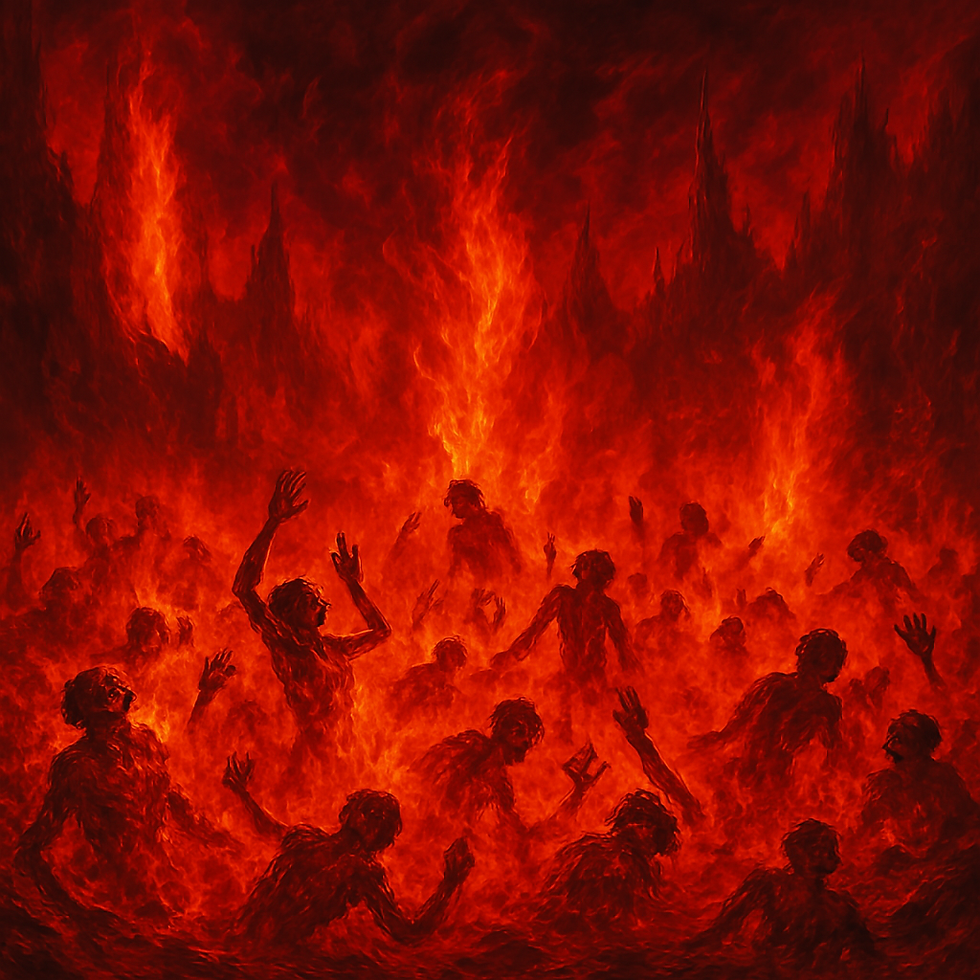
In another passage of his prophecies, Isaiah speaks of the eternal fire of Hell. “The sinners in Sion are afraid… Which of you can dwell with devouring fire (cum igne devorante)? Which of you shall dwell with everlasting burnings.” (cum ardoribus sempiternis).”
Speaking of the Last Judgment and Resurrection, the Prophet Daniel, who lived two hundred years after Isaiah, said: “And many of those that sleep in the dust of the earth, shall awake: some unto life everlasting, and others unto reproach, to see it always.”
The other Prophets say the same thing, right up to the Precursor of the Messiah, Saint John the Baptist, who also speaks to the people of Jerusalem about the eternal fire of Hell as a truth known by all and which no one ever doubted. Whose fan is in his hand, and he will thoroughly cleanse his floor and gather his wheat (the elect) into the barn; but the chaff (sinners) he will burn with unquenchable fire.” (in igne inextinguibili).
Greek and Latin pagan antiquity also speaks to us about Hell and its terrible punishments which will have no end. We always find belief in a Hell, a Hell of fire and darkness, though the conception of it varies in accuracy depending on the extent to which the peoples departed from the primitive traditions and the teachings of the Patriarchs and Prophets.
This is the Tartarus of the Greeks and the Latins. “The wicked who have despised the holy laws are cast into Tartarus, never to leave it, and to suffer horrible and everlasting torments”, says Socrates, quoted by Plato his disciple.
And Plato says again: “We must give credence to the ancient and sacred traditions which teach that after this life the soul will be judged and punished severely if it has not lived as it should have.” Aristotle, Cicero and Seneca speak of these same traditions which are lost in the midst of time.
Homer and Virgil depicted them vividly in their immortal poetry. Who has not read the account of Aeneas’ descent into Hell where, under the name of Tartarus, Pluto, etc., we find the great primitive truths distorted but conserved by paganism? The torments of the wicked are eternal and one of them is depicted as “fixed eternally in Hell.”
The sceptic philosopher Bayle is the first to note and acknowledge this universal, incontestable and uncontested belief. His companion in Voltairianism, the Englishman Bolingbroke, admits it just as openly. He says outright: “The doctrine of a future state of reward and punishment seems to be lost in the darkness of antiquity. It precedes everything we know with certainty. Once we begin to unravel the chaos of ancient history, we find this belief firmly anchored in the spirit of the first nations we know.”
We even find remnants of it among the warped superstitions of the savages of America, Africa and Oceania. The paganism of India and Persia have retained striking vestiges of it. Finally, Hell is one of the dogmas of Mohammedanism.

It goes without saying that the dogma of Hell was openly taught in Christendom as one of the great fundamental truths which serve as the basis for the entire edifice of Religion. The Protestants themselves who destroyed everything with their insane doctrine of “free inquiry” did not dare touch Hell. Strangely and inexplicably, in the midst of so many ruins, Luther, Calvin and the others had to leave this frightening truth standing, nonetheless a truth which must have been such an inconvenient one for them personally!
Therefore, all peoples of all times have known and acknowledged the existence of Hell. Therefore, this terrible dogma is part of that treasure of great universal truths which constitute the light of humanity. Therefore, it is not possible for a sane man to call it into question, saying in the madness of his proud ignorance: “There is no Hell!” Therefore, there is a Hell.
REFERENCE: De Segur, Mgr. Louis Gaston. Hell is Heaven’s Great Missionary. 1876. Translated by Peadar Walsh. Te Deum Press, 2021.
“Think often and seriously about Hell, its eternal punishments, its voracious flames, and I promise you that you will go to Heaven. Hell is Heaven’s great missionary.” Monsignor Louis Gaston de Segur

Monsignor Louis Gaston de Ségur (1820–1881) was a French Bishop and a zealous apologist for the truths of the Catholic Faith. Born into a noble family in Paris, he first served in diplomacy before, through the grace of God, renouncing the world to embrace the priesthood and dedicate himself to God.
Stricken with blindness in the midst of his labors, he accepted this trial resigning himself to God will. He continued his apostolate with remarkable perseverance, dictating numerous works for the instruction of the faithful. Endowed with clarity of mind and firmness in doctrine, Monsignor de Ségur wrote with the purpose of defending the teachings of the Church against the errors of his time and of leading souls to the knowledge and love of truth.
His writings, marked by simplicity, precision, and a deeply pastoral charity, were widely read and translated, serving as a bulwark against the growing tide of rationalism, indifferentism, and impiety in 19th-century Europe. He labored tirelessly for the salvation of souls, reminding the faithful of the eternal realities of Heaven, Hell, and judgment, and calling them to repentance and fidelity to the One, Holy, Catholic, and Apostolic Church.
Monsignor de Ségur is remembered as a courageous defender of the Faith and a devoted shepherd of souls, whose works continue to instruct and strengthen those who seek to remain steadfast in the truth handed down from the Apostles.


Comments